

CULTURE & IDENTITY · FIRST PERSON
“I ended up texting three different aunties in my building’s WhatsApp group before I found an Indian grocery store that stocked pooja items.”
That’s the sentence I never imagined saying after moving abroad.
Balancing Indian culture and life in Canada isn’t something most learn overnight. It often starts with surprisingly practical moments, like trying to find pooja items for your first Karva Chauth, figuring out where festivals are celebrated, or discovering a local South Asian community that makes Canada feel a little more like home.
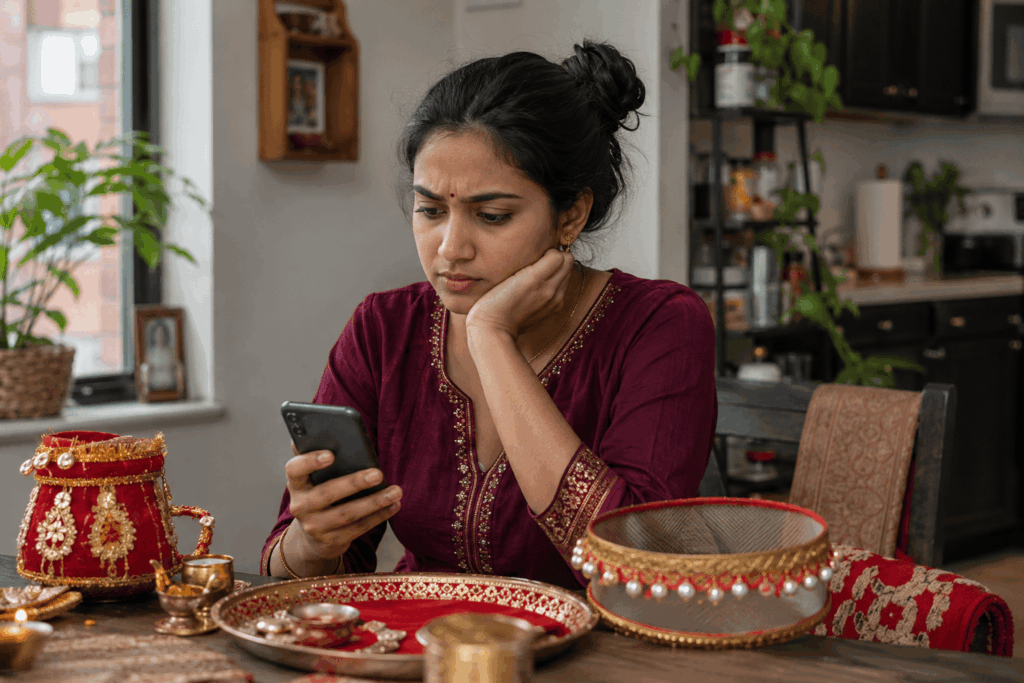
That’s what happened a few weeks before my first Karva Chauth in Canada, when I realized I had no idea where to actually get a proper thali, a chalni, or even the right kind of sindoor here. Back home, this stuff was just around,you didn’t source it, it existed in every third shop on the street. Here, it took a group chat and a lucky tip to find a store that stocked pooja items, tucked in the back behind the snack aisle.
That’s the actual question most of us are asking, one to five years in,not some deep philosophical one about identity, but a genuinely practical one: where do I get this, who else is doing this, and how do I make it happen without the fifteen people who would’ve helped me back home?
01 · REFRAME
What Does Balancing Indian Culture and Life in Canada Really Mean?
For many NRIs, balancing Indian culture and life in Canada is less about choosing between two identities and more about creating a life that feels authentic.
Before getting into the practical stuff, it’s worth naming something honestly: a lot of us don’t actually experience this as balancing two cultures pulling in opposite directions.
It’s less like a scale trying to stay level and more like building something that didn’t exist before,a specific Canadian NRI identity that isn’t a diluted version of Indian, and isn’t an attempt to become fully Canadian either. It’s its own thing.
That reframe matters, because “balance” implies a problem to solve, a tension to manage down to zero. Most people a few years into this aren’t in crisis about it. They’re just making a long series of real, specific decisions,what to keep exactly as it was, what to adapt, what to quietly let go of,and that process doesn’t need to resolve into either category to count as a full, legitimate life.
One of the biggest parts of balancing Indian culture and life in Canada is finding new ways to celebrate festivals when family isn’t around.
02 · LOGISTICS
Recreating Festivals: The Actual Logistics
Here’s the practical part, because this is where most people genuinely get stuck.
Finding the materials. Most cities with any real South Asian population have at least one Indian grocery store that stocks festival items,pooja thalis, diyas, karva chauth sieves, rangoli colours, festive sweets closer to the date. It’s rarely obvious from the outside; ask in local community Facebook groups which store carries what, since not every Indian grocer stocks the same seasonal items, and stock often shows up only a week or two before the actual festival.
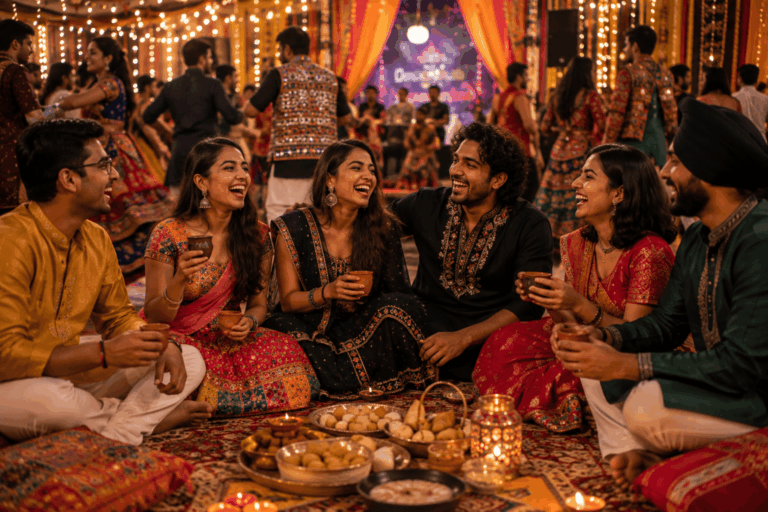
Finding the community version. This is the part that actually makes a festival feel real, versus just observed alone in an apartment. Gurudwaras and temples run public Vaisakhi and Diwali events. Cultural associations,Gujarati Samaj chapters, local South Asian community groups,organize Karva Chauth meetups specifically so women don’t have to observe it solo, and Navratri garba nights that run for multiple nights during the season, not just one evening. These exist in most cities with any real South Asian density; the trick is knowing to look, since nothing here reminds you the way the actual environment does back home.
Doing it without the built-in support network. Back home, your mother-in-law tells you exactly what the Karva Chauth thali needs. Your cousins show up to help you get ready. Here, you’re often piecing this together from memory, a phone call home, or a YouTube video,which is genuinely harder, but also very doable, and most people find their version gets easier and more confident each year they do it.
Another challenge of balancing Indian culture and life in Canada is explaining your everyday reality to family back home.
03 · FAMILY
The Gap Between What Your Family Imagines and What’s Actually True
This is worth addressing directly, because it causes real friction on video calls. Family back home tends to picture Canada as one of two extremes,either a glamorous, effortless Western success story, or a cold, isolating place where you’re struggling alone. The actual truth is neither, and it’s genuinely hard to explain across a video call.
The real version: a fairly ordinary, busy suburban life. A South Asian community that’s strong but takes real effort to access, not one that surrounds you automatically. Winters that are difficult in a way that’s almost impossible to explain to someone who’s never lived through one,it’s not just “cold,” it’s dark by 4:30 PM, it’s checking three weather apps before deciding what to wear, it’s a specific low-grade exhaustion that builds over months. And distances that don’t map onto anything back home,there’s no auto-rickshaw you flag down for a five-minute errand; everything requires a car and real travel time, and most things close earlier than you’d expect, especially on a weeknight.
None of this is dramatic enough to explain easily in a ten-minute call, which is part of why the gap persists. It’s not that your family doesn’t care to understand,it’s that the specific texture of daily life here doesn’t translate into a short conversation.
During festival season, balancing Indian culture and life in Canada often means creating traditions instead of waiting for them to happen naturally.

04 · SEASON
Why the Festival Season Doesn’t Feel the Same Here
In India, you don’t have to try to notice Diwali is coming,it’s in the air weeks before, in the markets, the decorations, the general hum of the whole country gearing up. Here, nothing in the environment does that work for you. The date can genuinely sneak up on you if you’re not deliberately tracking it.
This is a big part of why community events carry so much weight for NRIs specifically,they function as the seasonal cue that the environment used to provide automatically. A Diwali mela, a Navratri garba night, a Vaisakhi parade,these aren’t just social outings. They’re often the thing that actually makes a festival register as real and present, rather than just a date on a calendar you almost missed. Finding and showing up to these regularly does more to keep the calendar alive than almost anything else you can do alone at home.
For many newcomers, balancing Indian culture and life in Canada also means learning how to navigate changing family expectations.
05 · INDEPENDENCE
The Video Call That Asks the Same Question Every Week
Here’s a specific, recognizable tension worth naming honestly: a lot of people in Canada are living independently for the first time in their lives,making their own decisions about diet, relationships, social life, and religious observance in ways that simply weren’t available or accepted back home.
And then the video call happens. The same question from last week, asked again, gently but persistently,about a relationship, a career choice, whether you went to a specific pooja, why you sounded tired. It’s not usually malicious. It’s often just a parent trying to stay connected to a life they can only see in fragments, through a screen, from thousands of kilometers away. But it’s genuinely hard to sit in,the pull between a new independence you’re still getting used to, and a family relationship that hasn’t fully adjusted to that independence yet.
There’s no clean fix here. What helps most people is treating it as an ongoing, ordinary part of this life stage, not a problem specific to your family,most people a few years into life here are having some version of this same call, more often than anyone says out loud.
Community plays a huge role in balancing Indian culture and life in Canada, especially when you’re building a support system from scratch.
06 · COMMUNITY
Where JalsoLife Actually Fits Into This
A lot of what makes this whole thing lighter isn’t a mindset shift,it’s just knowing what’s happening and when. JalsoLife exists specifically to solve the “how do I find the community version of this” question,Karva Chauth meetups, multi-night Navratri garba events, Vaisakhi parades, Diwali melas,for Gujarati and Punjabi families across Canada and the US, without relying on a WhatsApp forward that arrives a day too late.
It doesn’t replace the work of building this new, specific version of your identity. But it does replace the environment that used to remind you a festival was coming,which, it turns out, is most of what you actually need.
There isn’t one perfect way of balancing Indian culture and life in Canada. Every NRI builds their own version over time, one festival, one friendship, and one community event at a time.
Quick-Fire FAQs
Where do I find Karva Chauth or pooja materials in Canada?
One practical part of balancing Indian culture and life in Canada is knowing where to find festival essentials. Most Canadian cities with a well-established South Asian community have at least one Indian grocery store that stocks pooja thalis, diyas, rangoli colours, sweets, and other seasonal items. However, inventory varies from store to store and often arrives only a week or two before major festivals. The easiest way to find the right place is to ask in local South Asian Facebook or WhatsApp community groups—someone will almost always know which Indian grocery store your city relies on for festival shopping.
How do I find a Navratri or Karva Chauth community event near me?
Cultural associations, gurudwaras, temples, and community event platforms are more reliable than a general search, which tends to surface only the largest commercial events.
Is it normal to feel like I’m not fully Indian or fully Canadian?
Very common, and many people describe it less as a problem and more as a legitimate third identity,a specific Canadian NRI experience that doesn’t need to resolve into either category.
How do I explain how different Canada actually is to family back home?
Specific, concrete details land better than general reassurance,describe an actual weekday, a grocery run, a winter evening, rather than trying to summarize the whole experience in one call.
How do I handle recurring questions from parents about my personal choices here?
There’s no universal fix, but treating it as a normal, ongoing part of this life stage,rather than a personal conflict,tends to help more than trying to resolve it in a single conversation.
A Few Practical Starting Points
- Find your city’s Indian grocery store that stocks festival and pooja items
- Join a local cultural association or community group ahead of major festival season
- Look up Navratri, Karva Chauth, or Vaisakhi community events at least two weeks before the date
- Set a calendar reminder for major festivals, since the environment here won’t remind you
- Have one honest, low-stakes conversation with family back home about what a normal week here actually looks like
- Check JalsoLife or local community groups regularly during festival season
The One Thing to Actually Do
Before the next festival on your calendar, do the one practical thing that makes the rest easier: find out where your city’s version of it is happening, and go. Not to resolve anything, not to prove anything to family back home,just to stand in a room where the season actually feels present again.






 Previous Post

