

CULTURE & IDENTITY · FIRST PERSON
The Truth About Your First Diwali Away From Home
01 · A MORNING LIKE ANY OTHER
A Morning Like Any Other
The first Diwali after I moved to Canada didn’t feel real.
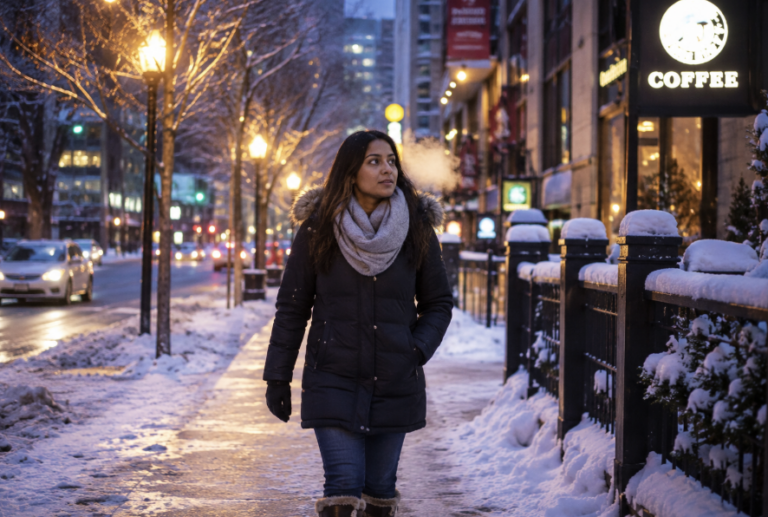
I woke up at the usual time, got ready for work the way I did every other day, grabbed my coffee, and caught the bus like it was any regular weekday. Nobody wished me “Happy Diwali” on the way. There were no lights outside the houses I passed, no smell of sweets in the air, no neighbours playing old Bollywood songs a little too loudly the way they always did back home. Everything around me looked exactly the same as it had looked yesterday.
Back home, this same morning would have looked completely different.
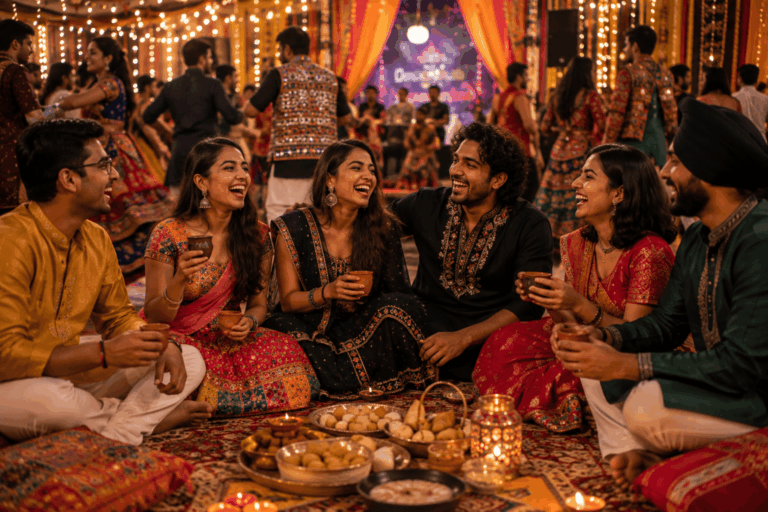
My mum would already be in the kitchen by 6 a.m., moving around like she’d done this a hundred times before, because she had,a pot of milk boiling for the sweets, a strict unspoken rule that nobody touches anything until evening. My dad would be outside, going through the string lights from last year, testing each one twice even after he’d already tested it once. My cousins would be flooding the family WhatsApp group, arguing over who was bringing the crackers this time, someone sending a blurry photo of a half-finished rangoli captioned “don’t judge, still going.”
I didn’t think I would miss any of that.
I thought, if anything, I’d miss home in some general way,the house, the food, maybe my bed. I didn’t realise, until that bus ride, that what I’d actually miss was the noise.
02 · THE PHOTOS
The Photos That Kept Coming
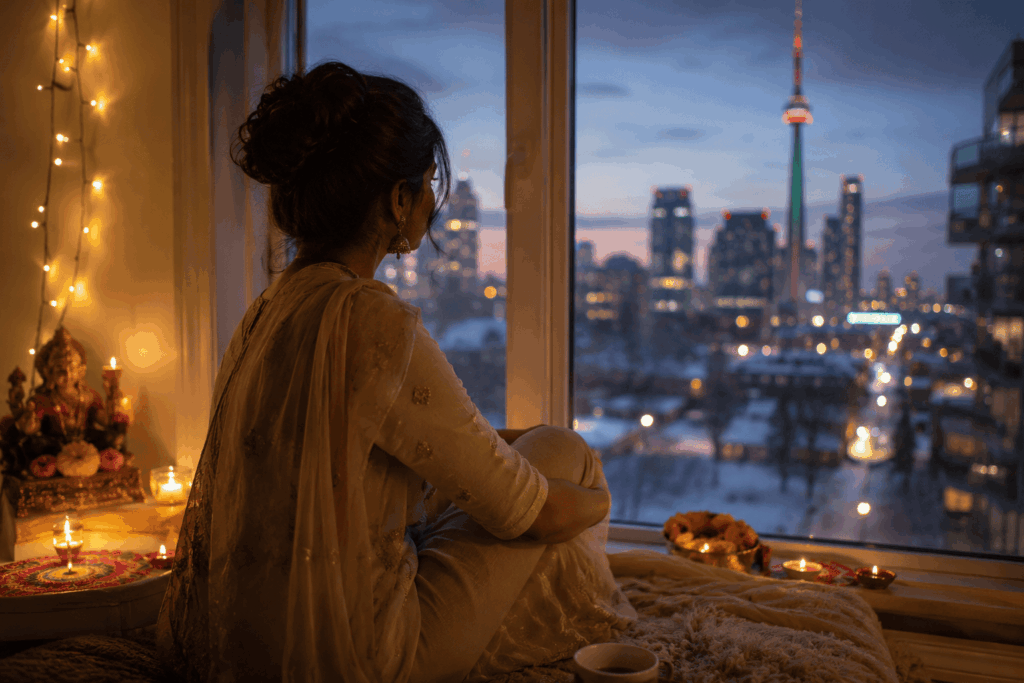
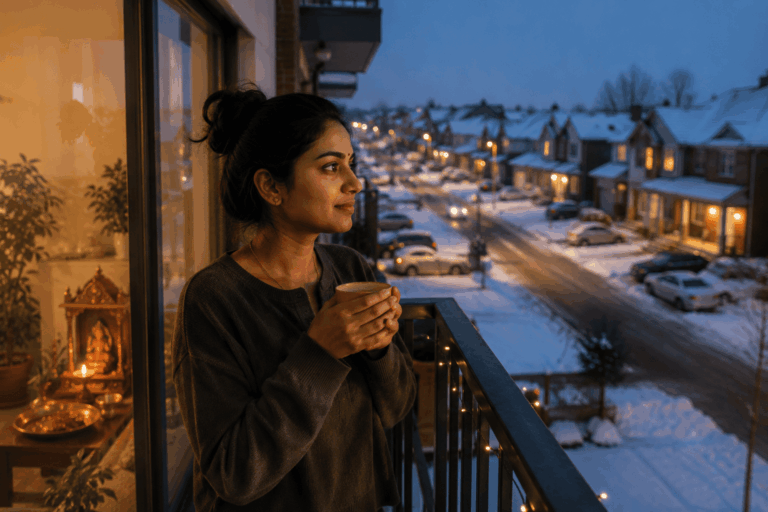
That evening, I came back to my apartment, made myself a cup of chai, and sat near the window. My phone wouldn’t stop buzzing. Photos from home kept coming, one after another. My mum in her red saree, mid-laugh at something off-camera. My dad crouched down, lighting the first diya on the front step. My cousins all crammed into one frame, someone’s eyes closed, because someone’s eyes are always closed in these photos.
Everyone looked happy. I smiled at every picture, and I meant it,I was glad they were together, glad the house was lit up the way it always was.
But with every new photo, my apartment somehow felt a little quieter. The lighting hadn’t changed. Nothing around me had actually gotten darker. It just felt that way.
That’s when it finally hit me, sitting there with my chai going cold in my hands.
It wasn’t that I was alone. I’d been alone plenty of evenings since moving here, and none of them had felt like this.
It was that Diwali had always meant being with people, and for the first time in my life, there was nobody walking into my room asking, “Are you ready yet?”
03 · WHAT NOBODY TELLS YOU
Nobody Warns You About This Part
Nobody really talks about this before you move abroad.
People tell you about getting your visa sorted, finding your first job, opening a bank account, learning to drive in the snow, figuring out Canadian winters. They tell you where to buy Indian groceries and which phone plan is actually worth it. Somebody always warns you about the cold. Nobody warns you about this.
The funny thing is, everyday life abroad slowly becomes normal. You find your favourite grocery store. You know which bus to catch without checking the app. You stop needing directions for the walk to work. You learn where to get fresh coriander and which restaurant actually tastes close to home. You make a friend or two. Life settles into a rhythm, and before you know it, you’ve quietly started calling this new place home too, without ever officially deciding to.
Then a festival arrives.
And suddenly, all of that rhythm disappears for one day.
Diwali isn’t just another date on the calendar. It’s tied to memories you’ve had since childhood, memories you never once thought to name because you never had to live without them. Maybe your family always starts decorating two days early, even though it’s never necessary. Maybe your mum insists on making one sweet by hand every year, even though everyone tells her it’s easier to just buy it. Maybe your dad checks every light twice. Maybe your grandparents tell the exact same three stories every single year, and everyone still stops to listen, like it’s the first time.
Growing up, none of it feels significant. It’s just background noise,the wallpaper of your childhood, so constant you stop seeing it.
It’s only from thousands of kilometres away that you realise: that wallpaper was the celebration.
04 · WHAT IT LOOKS LIKE
What Loneliness Actually Looks Like
People often think loneliness on a day like this means crying all day.
Most of the time, it doesn’t look anything like that.
It looks quieter. Smaller.
It looks like standing in an Indian grocery store, staring at a shelf of sweet boxes, and buying the smallest one because a whole kilo doesn’t make sense for one or two people.
It looks like wearing your favourite kurta anyway, even though you’re not going anywhere and nobody will see it.
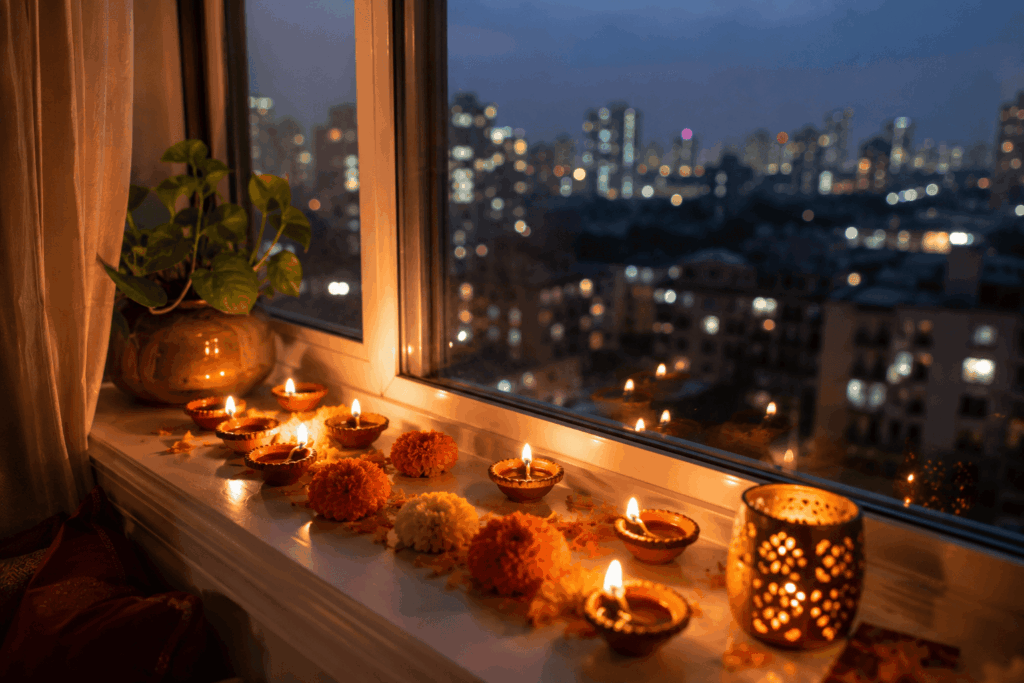
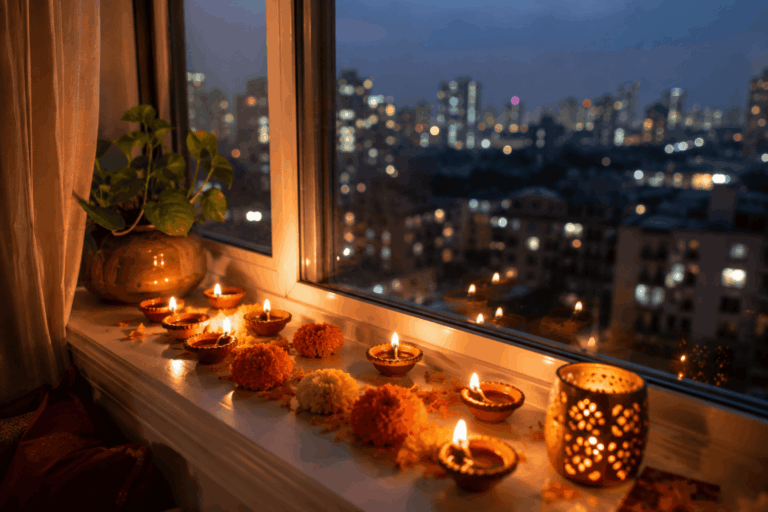
It looks like lighting one diya on your apartment windowsill and just standing there a few extra minutes, watching it, for reasons you can’t fully explain.
It looks like opening your family WhatsApp group ten times in one hour, not because you expect new messages, but just to look at the last photo one more time.
It looks like joining the family video call, smiling the whole time, laughing at every joke, asking how the sweets turned out,and then hanging up, and sitting in a silence that somehow feels louder than before the call even started.
If you’ve felt any of that, you’re not the only one.
Almost every NRI I’ve spoken to has a festival that made them stop and think, I didn’t expect this to be so hard. And that’s okay. It doesn’t mean you’re unhappy abroad(with your new life). It doesn’t mean you made the wrong decision moving. It simply means some memories are so deeply woven into specific people, in a specific kitchen, on a specific evening, that no amount of gratitude for your new life replaces them overnight.
05 · SOCIAL MEDIA
The Comparison Trap
Social media doesn’t make any of it easier.
Your feed fills up with cousins in matching outfits, perfectly done rangolis, dinner tables groaning under mithai, everyone posing in front of houses lit up like they’re competing for something. You know those are highlight reels. You know nobody’s posting the argument over who forgot to buy the crackers, or the fact that your cousin was actually stressed about something completely unrelated the whole evening.
You know all of that.
But logic doesn’t always win. Not at 9 p.m., alone, holding a phone that suddenly feels heavier than it should.
06 · IT GETS EASIER
It Doesn’t Stay Like This Forever.
The good news,and I didn’t believe this the first year, but I believe it now,is that it doesn’t last forever.
Every NRI I’ve met has a story about their first lonely Diwali. Ask someone who’s been here ten years, and they’ll usually smile before telling you about the year they ate takeout alone because they didn’t know a single other Indian family in the city. Ask someone who’s been here fifteen, and they’ll tell you about the first time they hosted Diwali themselves, in their own home, with friends who’d also left India behind to build something new here.
That’s how it changes. Slowly. Without you noticing it happening.
One year, you’re spending Diwali alone.
A few years later, you’re the one inviting someone else who just landed in Canada and doesn’t know anyone yet.
That’s how new traditions begin. Nobody plans them in advance. They start with someone saying, “Don’t stay home alone tonight. Come celebrate with us.”
Those invitations matter more than people realise. Sometimes they’re from a neighbour. Sometimes a colleague. Sometimes another Punjabi or Gujarati family you’d met only a few weeks before. Nobody expects those people to replace your family. They never can. But they remind you that home isn’t only a place,it’s also the people who make sure you don’t celebrate alone.
07 · IF THIS IS YOU RIGHT NOW
If This Is Your First Diwali Away
If this is your first Diwali away from India, be kind to yourself tonight.
Call your parents, even if it’s only for a few minutes. Light a diya, even if it’s just one. Wear your favourite kurta or saree, even if you’re staying in. Say yes if someone invites you over, even if you barely know them.
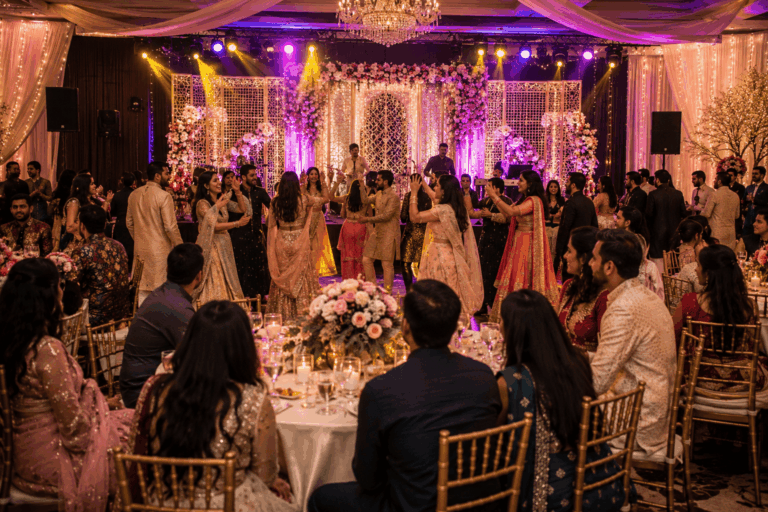
And if nobody invites you, look for a local Diwali event nearby. You might walk in knowing nobody. You could walk out with people you’ll be celebrating with for years.
The first festival away from home is always the hardest, because you’re comparing it to every Diwali you’ve ever known. The next one feels a little easier. The one after that feels different, in a good way. Slowly, your new memories start standing beside the old ones instead of trying to replace them.
You’ll still miss home. You’ll still miss your mum’s cooking. You’ll still wish you could be in that family photo instead of just looking at it.
But one day, you’ll look around your own living room, filled with people who also left home to build a life somewhere new, and you’ll realise something quietly beautiful.
Home didn’t disappear when you moved.
It simply grew big enough to exist in two places at once.


 Previous Post

