

What Janmashtami 2026 Looks Like Once You’re the One Celebrating It
I grew up hearing about Krishna Janmashtami long before I understood who he actually was. My grandmother would tell me stories at bedtime, half performance and half warning, about a mischievous little boy in Gokul who stole butter from every house in the village and somehow still had the whole place completely in love with him. She’d lower her voice at the good parts, pause dramatically before the twist, and act out the scoldings from imaginary neighbours as if she’d witnessed them herself. I didn’t know then that I was being handed something bigger than a bedtime story. I was being handed the beginning of a relationship with a figure who would keep showing up in my life, at temples, at festivals, in the songs my mother hummed while cooking, all the way into the community halls I now walk into every September, thousands of kilometres from the village those stories were originally set in.
It’s only as an adult, living abroad and watching my own community gather every year to celebrate him, that I’ve really started paying attention to how much of Krishna’s story we’re retelling every time we light a diya, decorate a cradle, or fast until midnight.
01 · THE STORIES
The Boy Who Stole Butter and Never Really Stopped Stealing Hearts
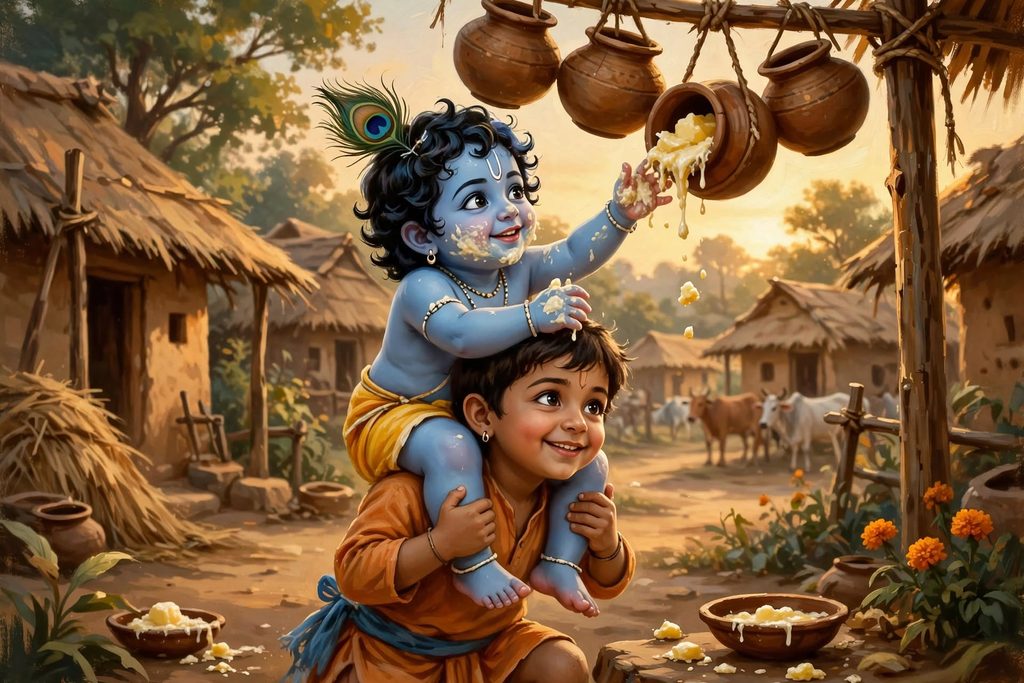
The Krishna I met first wasn’t the wise figure from the Bhagavad Gita. He was a toddler in Gokul, small enough to fit into a mother’s lap, and mischievous enough to drive an entire village half-crazy. The stories my grandmother told me were always about the butter, how baby Krishna would sneak into neighbours’ homes, climb onto the shoulders of his friends to reach pots hung deliberately out of reach, and walk away with smeared hands and an expression that somehow made everyone forgive him instantly, even the aunties who’d sworn they’d finally caught him this time.
What I understand now, and what I don’t think I fully grasped as a kid, is what those stories were quietly teaching me underneath the butter. Krishna chose to be lovable before he chose to be powerful. He let an entire village scold him and adore him in the same breath, and he made devotion feel less like duty and more like something you couldn’t help but feel. That’s still the emotional core of every Janmashtami I’ve attended since, the sense that this is a god you’re allowed to laugh with, not just kneel before.
02 · KRISHNA’S STRENGTH
The River, the Serpent, and the First Time Krishna Showed His Strength
The story that made me sit up as a kid was the one about Kaliya, the venomous serpent living in the Yamuna river, poisoning the water so badly that nothing near it could survive, not the fish, not the cattle who came to drink, not even the trees along the bank. Young Krishna, still just a boy by every account, jumped straight into that poisoned river without a second thought, danced on the serpent’s many hoods until it grew weak and surrendered, and then simply asked it to leave rather than destroying it outright.
I remember asking my grandmother why Krishna didn’t just kill the snake if he was strong enough to defeat it. She told me that was exactly the point. Krishna’s strength was never really about destruction. It was about restoring balance and then choosing mercy once that balance was restored. That story stayed with me longer than almost any other, because it was the first time I understood Krishna as someone who used his power carefully, not carelessly, and it’s a distinction I find myself thinking about far more as an adult than I ever did as a child.
03 · RAAS LEELA
Raas Leela and the Kind of Love That Doesn’t Ask to Be Understood
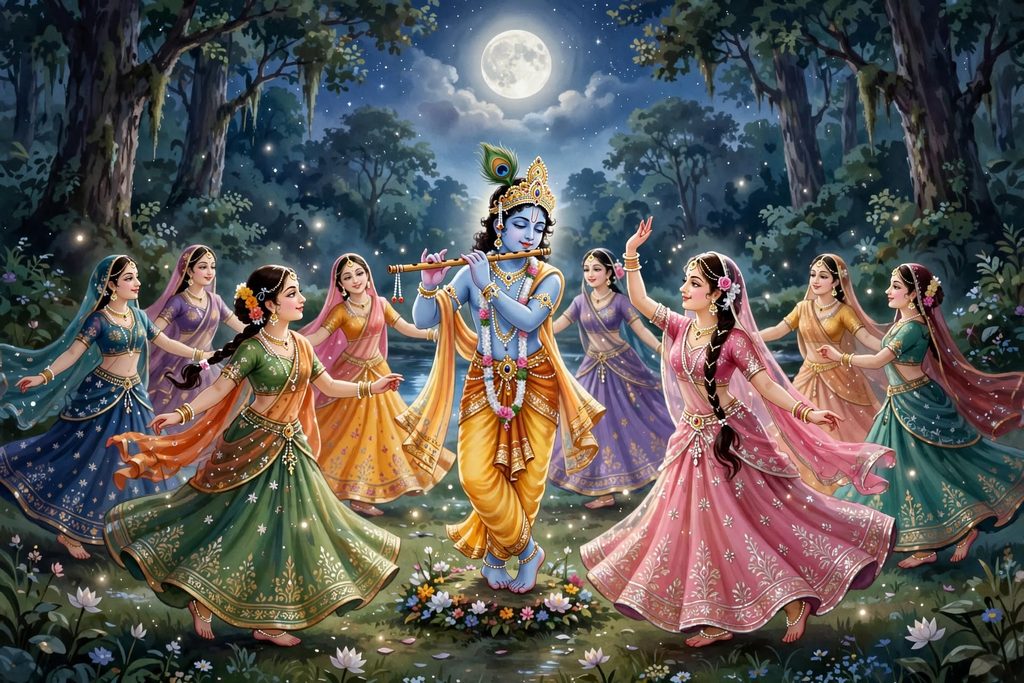
As I got older, the stories shifted from mischief to something far more layered, the moonlit gatherings in Vrindavan where Krishna danced with Radha and the gopis in what’s known as the Raas Leela. I felt slightly confused by this part the first time I heard it properly explained, a god dancing with devotees under the moon, each one believing he was dancing with her alone, the melody of his flute pulling every one of them out of their homes and into the forest at once.
It took me years to understand that this wasn’t a story about romance in the way I originally assumed. It was a story about a love so complete that it didn’t need to be divided or explained, only felt. Radha and Krishna’s bond has become shorthand in our culture for a kind of devotion that goes beyond logic, and every time I see their names painted together on a temple wall or hear a bhajan built around their story, I think back to that confusion I felt as a kid, and how much closer I feel to understanding it now, even if I still can’t fully explain it in words.
04 · THE BHAGAVAD GITA
The Friend on the Battlefield Who Became the Voice of the Gita
By the time I reached the Mahabharata, Krishna had transformed again, this time into Arjuna’s charioteer and closest friend, standing beside him at Kurukshetra as war was about to break out between two sides of the same family. I was struck by how human that moment felt, a warrior frozen by doubt, his bow slipping from his hands, and a friend who didn’t just hand him confidence, but sat with him through every question before he was ready to act.
The guidance Krishna offers Arjuna in that moment became the Bhagavad Gita, one of the most significant texts in our culture, built around duty, purpose, and the idea of doing what’s right without being consumed by the outcome. I won’t pretend I understood any of that as a teenager, half listening during a puja while waiting for the prasad to be served. What I understood was simpler: that even a god chose to show up as a friend first, in someone’s darkest and most uncertain moment, rather than arriving only to perform miracles.
05 · JANMASHTAMI
What Janmashtami Looks Like Once You’re the One Celebrating It
For years, Janmashtami was something that happened around me. My parents fasted, my grandmother told the stories, and I mostly showed up for the midnight aarti half asleep, more excited about the prasad than the philosophy. It’s only in the last few years, organising my own plans around the festival instead of just following my family’s lead, that I’ve understood how much preparation goes into that one night.
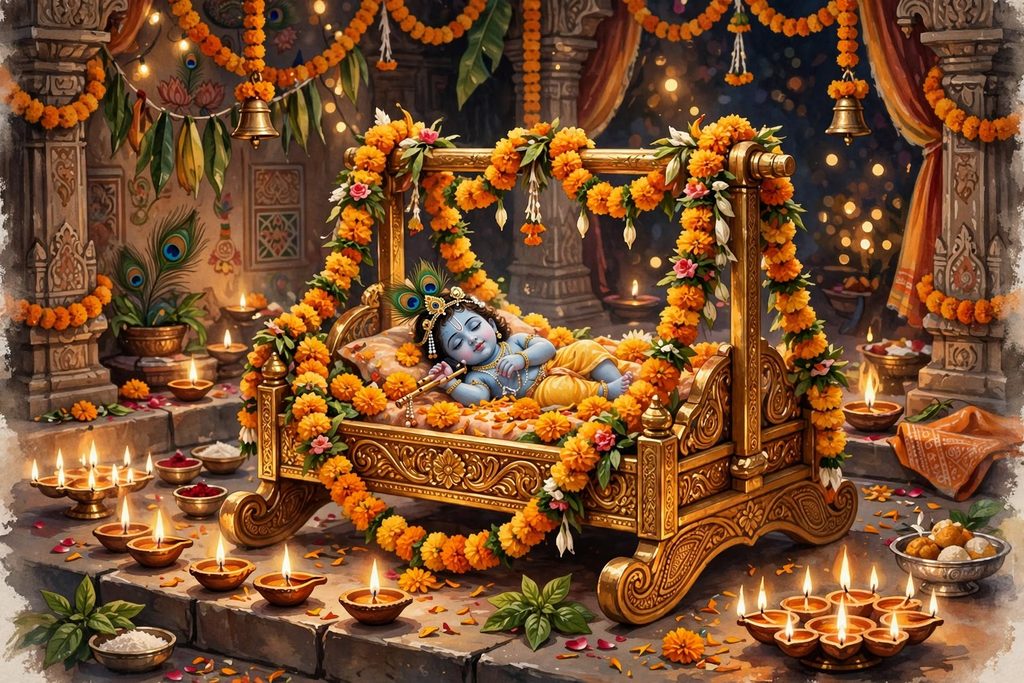
Janmashtami usually falls in late August or early September, and in 2026, most temples across Canada are marking it in that first week of September, with several observing it a day apart depending on whether they follow the Smarta or Vaishnava tradition, and ISKCON-affiliated temples typically aligning with the Vaishnava date. Many devotees observe a full day’s fast, some allowing fruits and milk, others going without anything at all, breaking it only after the midnight hour, the moment believed to mark Krishna’s birth. Temples spend weeks preparing for it, decorating the deity’s cradle for the jhulan ceremony, rehearsing bhajans, and setting up elaborate displays depicting scenes from Krishna’s life, the same stories I grew up hearing from my grandmother, now recreated in miniature dioramas for a whole community to walk past on their way to the sanctum.
06 · DAHI HANDI
Dahi Handi and the Part of the Festival That’s Pure Joy
If Janmashtami night is about devotion, the next day is about pure, chaotic celebration. Dahi Handi recreates Krishna’s butter-stealing days almost literally, with young men forming human pyramids to reach a pot of curd hung high above the ground, the way baby Krishna once climbed onto his friends’ shoulders to reach pots hung out of his grasp. I’ve watched this happen at community events abroad, and there’s something moving about seeing a five-thousand-year-old story turned into a competitive, laughing, thoroughly modern spectacle in a parking lot outside a temple or community hall, with kids on their parents’ shoulders cheering the pyramid on.
It’s one of the few festival traditions where the retelling isn’t quiet or reflective. It’s loud and physical, joyfully imperfect, which feels like exactly the right way to honour a god who was never interested in being taken too seriously.
07 · CARRYING THE STORIES
Carrying These Stories Somewhere New
What I’ve come to appreciate most, watching my own community gather for Janmashtami every year abroad, is that we’re not just marking a religious date on a calendar. We’re passing down the exact same stories my grandmother once told me, the butter theft, the serpent in the river, the dance under the moon, the friend on the battlefield, to an entirely new generation of kids hearing them for the first time in a country thousands of kilometres from where they were originally set.
That’s the part that gets me every year. Krishna’s stories were never really about Gokul or Vrindavan specifically. They travelled with every family that left India carrying them, and they’re still travelling now, showing up in community halls, temple courtyards, and living rooms across Canada each September.
If you’re looking for where your own community is celebrating Janmashtami this year, from the temple gatherings to the Dahi Handi events happening across the city, that’s exactly the kind of thing JalsoLife was built to help you find.
08 · QUESTIONS
Questions People Ask Me Around Janmashtami
When is Janmashtami in 2026?
This is the question I get asked most every year, and the honest answer depends on which tradition your family or temple follows. In 2026, Janmashtami falls in late August into the first week of September, with the Smarta Sampradaya observing it slightly earlier and the Vaishnava Sampradaya, which most ISKCON temples follow, observing it a day or so later. I always tell people to check with their specific temple rather than assuming, since even families in the same city sometimes celebrate on different nights depending on which tradition they follow.
Why do people fast on Janmashtami?
I used to think the fast was just tradition for tradition’s sake, until my mother explained it to me properly. The fast is meant to mirror the anticipation of Krishna’s birth itself, a night of waiting, discipline, and devotion that ends only at midnight, the hour he’s believed to have been born. Some people fast completely without food or water, others allow fruits, milk, or specific vrat-friendly dishes throughout the day, and the fast is broken with prasad only after the midnight aarti is complete.
What is Dahi Handi and why is it celebrated?
Dahi Handi is the celebration that happens the day after Janmashtami, and it’s essentially a joyful recreation of Krishna’s childhood butter and curd thefts. Young men and boys form human pyramids to reach a clay pot filled with curd, yoghurt, or butter hung high above the ground, mimicking the way baby Krishna would climb onto his friends’ shoulders to reach pots deliberately hung out of reach. It’s become a competitive, high-energy event in many cities, especially in Maharashtra and Gujarat, and increasingly at South Asian community events abroad as well.
What’s the difference between Janmashtami and Gokulashtami?
Honestly, this confused me for years too. They’re essentially the same festival, just named differently depending on the region. Janmashtami is the more widely used name across most of North India and the diaspora, while Gokulashtami is common in Maharashtra and parts of South India, referring specifically to Krishna’s childhood home of Gokul. Both mark the same night, Krishna’s birth, and involve the same core rituals of fasting, midnight aarti, and prasad.
How can I celebrate Janmashtami if I don’t have a temple nearby?
This is something I had to figure out myself during my first year abroad, before I found a proper community. A home celebration can feel just as meaningful. Setting up a small cradle or image of baby Krishna, decorating it with flowers, singing a few bhajans, and staying up to do a simple aarti at midnight covers the core of the tradition. Breaking the fast with a small offering of milk, fruits, or panjiri afterward completes the night, even without a large temple gathering.





 Previous Post